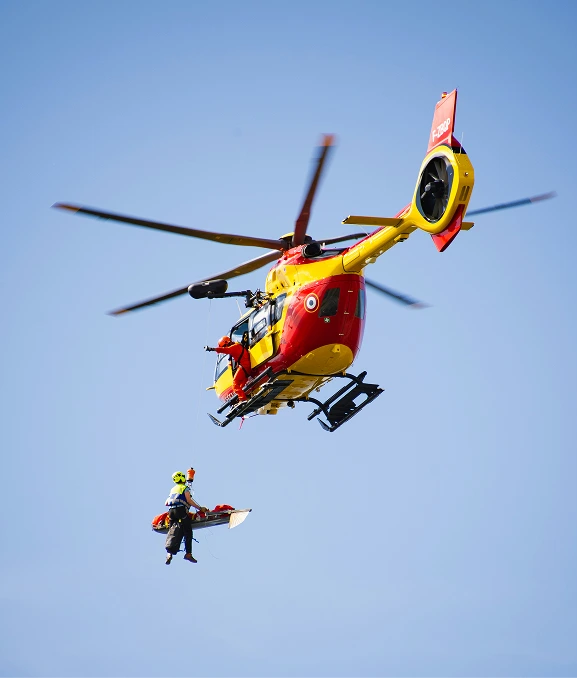
Protect your employees around the world with an international assistance solution available 24 hours a day, 7 days a week.
When an employee is the victim of a serious accident or sudden illness, or when an assignment is jeopardized by a security crisis, every minute counts. More than just covering medical expenses, the challenge is to quickly organize a medical evacuation, a safety evacuation, or medical repatriation under the best possible conditions. With its Emergency Assistance & Evacuation insurance, Geodesk supports companies, NGOs, institutions, and international organizations by mobilizing a 24/7 assistance platform, a medical dispatcher, and a network of partners present in more than 150 countries. As a 100% international specialist for 30 years—including in sensitive and high-risk areas—Geodesk designs each assistance program to be tailor-made, in line with the realities of your mission fields.
L’assistance et l’évacuation d’urgence regroupent l’ensemble des moyens humains, services médicaux et logistiques mobilisés pour protéger vos collaborateurs en difficulté à l’étranger, en cas de maladie grave, d’accident, de catastrophe naturelle, de crise politique ou d’insécurité. Contrairement à une assurance santé internationale qui rembourse principalement les frais médicaux, un service d’assistance agit immédiatement sur le terrain.
→ Call a dispatch physician
→ Contact the local medical team
→ Charter a medical evacuation aircraft
→ Identify the most appropriate facility
→ Arrange medical transport (ambulance, medical evacuation aircraft, or commercial flight with medical escort)
→ reserving a hospital bed
→ coordinating ground transportation and monitoring the patient until they reach their destination
Without active assistance, even the best health insurance in the world will not trigger a medical evacuation.
Emergency assistance actually encompasses several situations that contracts often conflate, even though they are based on very different principles. Medical evacuation involves transferring a patient to a facility capable of providing appropriate care when local medical infrastructure is inadequate. Medical repatriation involves arranging for the patient’s return to their country of residence when their health condition permits or requires it. Security evacuation protects employees exposed to a sudden deterioration in local conditions, whether due to civil unrest, armed conflict, a natural disaster, or a security threat. Early return arranges for an employee’s return home in the event of a serious family emergency.
For companies, each of these benefits is subject to its own triggering rules, exclusions, and coverage limits: this is precisely where Geodesk steps in, verifying that the contract covers the actual risks of your assignments and not just textbook scenarios. Inadequate coverage can lead to critical delays, denial of coverage, or particularly high costs for the employer.
An issue that is often underestimated. Geodesk understands the reality on the ground
An employee on assignment is the victim of a serious accident in a region where the local hospital lacks both the necessary equipment and specialists. The challenge is to determine, within a matter of minutes, whether the person needs to be evacuated and to which facility. The dispatch physician at the assistance platform communicates with the on-site medical team, assesses the person’s condition, and decides on the mode of transport—medical evacuation aircraft, commercial flight with medical escort, or ground transport—striving for the best balance between speed and safety. In this scenario, an evacuation does not necessarily bring the patient back to France or Europe: it directs them to the best-equipped hospital, sometimes in a neighboring country.
An organization deploys teams to a country where the security situation suddenly deteriorates. In this case, the trigger is not medical but political, and the real bottleneck is almost never the plane itself: it’s the overflight clearances, the corridors that are still open, the condition of the airports, and the time window available before access points close. A safe evacuation requires constant monitoring of on-the-ground developments and the ability to make quick decisions, with contacts who are already familiar with the case and the local context. This assurance is often absent or severely limited in standard contracts, which treat war and civil unrest as default exclusions.
An expatriate employee learns that a loved one back in their home country has been hospitalized or has died. The early return service organizes and covers the cost of their urgent return trip at a time when no one is in the right frame of mind to book a ticket or handle the logistics. Conversely, the same assistance network steps in when a death occurs at the assignment location: repatriation of the body, handling of consular and health-related formalities, and support for the bereaved family members. These situations, which employers rarely anticipate, fall squarely within the duty to protect employees on assignment.
From 24/7 medical assistance to medical repatriation and safe evacuation, Geodesk offers coverage tailored to every emergency situation. From the initial call to a safe return, we provide a comprehensive chain of assistance to protect your employees anywhere in the world.
Geodesk is a broker that specializes exclusively in international insurance, with over 30 years of experience and a network of international insurance partners
At Geodesk, no international insurance policy is off-the-shelf: each policy is negotiated and tailored to your company’s specific situation, your employees’ profiles, and the countries where they are assigned. From the initial contact through to the handling of any potential claims, you have a dedicated point of contact.
Geodesk currently supports
+
30
+
490
+
150
+
59
French schools and high schools abroad are protected
95
%
of satisfied customers.
A lasting relationship built on trust, based on active listening, responsiveness, and personalized support.
+
682
individuals abroad
+
59
clients served (microbusinesses, small and medium-sized enterprises, multinational corporations, expatriates, and self-employed individuals)
+
150
+
59
French schools and high schools abroad are protected
95
%
of satisfied customers.
A lasting relationship built on trust, based on active listening, responsiveness, and personalized support.

We’ll conduct a free review of your current international health insurance coverage and identify your areas of risk in less than 48 hours—with no obligation and in complete confidence.

We compare the available plans and negotiate coverage with our partner insurers, tailoring coverage limits, deductibles, and options to your destination country.

We set up the policy, the certificates, and access to the support platform so that every policyholder is covered even before they leave for a trip abroad.

A dedicated representative manages changes to the policy, claims, and 24-hour assistance throughout your employees’ stay.
Analysis of Your Needs
We’ll conduct a free review of your current international health insurance coverage and identify your areas of risk in less than 48 hours—with no obligation and in complete confidence.
Solution Architecture
We compare the available plans and negotiate coverage with our partner insurers, tailoring coverage limits, deductibles, and options to your destination country.
Deployment
We set up the policy, the certificates, and access to the support platform so that every policyholder is covered even before they leave for a trip abroad.
Follow-up & Support
A dedicated representative manages changes to the policy, claims, and 24-hour assistance throughout your employees’ stay.
URD Group
Le Groupe URD
“Dans le cadre de nos activités de think-tank de l’humanitaire, nous sommes souvent amenés à nous déplacer au cœur de terrains en crise. Nous avons toujours pu compter sur l’expertise et l’assurance de GEODESK »
Pain Without Borders
Pain Without Borders has been using Geodesk's services for several years. Geodesk regularly provides us with insurance solutions tailored to our experts' missions in our various areas of operation, particularly in Ukraine, Ivory Coast, and Mozambique. Communication is always smooth, quick, and efficient, and we are fully satisfied with our collaboration and the availability of our account managers. "
A. Lefevre
HR Director
“The travel of Better with Water employees is essential to the success of our field missions. Having a reliable insurance partner allows us to support them with peace of mind, wherever they are working. The quality of the support, the responsiveness of the teams, and the coverage tailored to our needs are a real asset for our organization and for the safety of our employees.”
X.ARNOULT
HR Director
“For several years, Geodesk and IECD have been developing a structured partnership to benefit the social protection of employees on international assignments. Present in 18 countries, IECD works to promote access to education, employment, and entrepreneurship. Geodesk's support helps to secure these initiatives in sometimes complex or fragile environments, particularly in Lebanon and Madagascar. This long-term partnership is based on a strong and shared relationship of trust between IECD and Geodesk, serving their common commitments on the ground.”
Reporters Without Borders
“RSF has been working with Geodesk for several years. We particularly appreciate the quality of their personalized support. Their teams are always responsive, available, and attentive to our needs. We appreciate their follow-up and always enjoy communicating with them.”
Jean-Paul SCHÜTZ
Principal
“The Lycée Français Alexandre Dumas in Moscow , a school directly managed by the AEFE (Agency for French Education Abroad), places the safety and well-being of its students at the heart of its priorities. This is why we attach paramount importance to the quality of the school insurance we have purchased from CGEA GEODESK. Our school welcomes over 660 students, from preschool to the final year of high school, from numerous nationalities and spread across three separate campuses. In such a demanding international environment, we need a reliable partner. CGEA GEODESK fully meets this requirement. The “INTERNATIONAL STUDENT SCHOOL INSURANCE” coverage protects our students during school hours, on educational outings, and during all extracurricular activities organized by the school, thus providing continuous protection tailored to our daily lives.”
In this new era of remote work, more and more employees are expressing a desire to work from abroad.
But be careful—this doesn’t mean that insurance policies and companies will always cover all risks in the event of an accident or problem.
When you work remotely from abroad, you aren’t necessarily on a business trip. As a result, policies may not cover all associated risks. That’s why some companies sometimes have employees sign liability waivers!
A business trip lasting just a few days does not eliminate the risk: it is often the situation for which people are least prepared and most vulnerable. An employee traveling for a 48-hour meeting may have an accident, fall ill, or find themselves stranded due to an unforeseen local event, without knowing who to call or how their expenses will be covered.
Geodesk’s international business travel insurance covers your business travelers for the specific duration of each trip: medical expenses, 24-hour assistance, and direct payment for emergency medical care to avoid out-of-pocket expenses. Each policy takes into account not only the destination country but also transit countries, which are too often overlooked by standard coverage.
Beyond medical assistance, Geodesk supports your employees in managing any unforeseen events that may arise during business travel. Whether it’s an interruption of a business trip, a security incident, an early return for family reasons, an evacuation, or any other critical event, our teams coordinate every step of the response promptly—from the initial report through to the complete resolution of the situation. This allows you to ensure the safety of your business travel, minimize the operational impact of incidents, and fulfill your duty of care toward your employees.
An expatriate does not leave for just a few weeks: he or she settles, sometimes with his or her family, in a country where he or she is unfamiliar with either the healthcare system or the legal framework. As soon as he or she leaves the French general social security system, his or her original social security coverage no longer applies, and the employer becomes liable in the event of a breach.
Geodesk’s expatriate insurance provides comprehensive and long-term coverage: health, accident, professional and personal liability while abroad, with coverage extended to the spouse and children. Each expatriate insurance policy is tailored to the host country, the employee’s actual status, and applicable local requirements.
Geodesk also handles the gray areas that standard contracts overlook: changes in employment status during an assignment, transition periods between two assignments, and temporary returns to France. These gaps, which are often not covered elsewhere, expose both the employee and the company to risk.
The cost of hospitalization abroad is unpredictable and can reach amounts far exceeding what a French health insurance plan reimburses. In the United States, just a few days in intensive care are enough to far exceed the coverage limits of a standard policy. For example, here are the average costs of a major hospitalization (3 to 5 days with surgery, depending on the condition):
The coverage limits recommended by Geodesk start at 1 million outside the U.S. and Canada, and at 5 million euros or unlimited, depending on the region
Geodesk’s international health insurance guarantees access to care in the country of assignment without any upfront costs, with coverage limits based on the actual cost of local care—not on a flat-rate schedule. Our team carefully reviews the specific coverage limits for intensive care and resuscitation, as well as deductibles and waiting periods—areas where unpleasant surprises often lurk.
This coverage extends to the employee's family when the assignment requires it, and is aligned with the local insurance requirements specific to each country. The goal is to ensure that no employee forgoes medical care and that no company finds itself facing an insufficient coverage limit when a claim arises.
Given the rising cost of healthcare—particularly in the United States, Canada, Singapore, and Switzerland—a coverage limit that is too low may leave the company responsible for a significant portion of medical expenses. Geodesk believes that HR directors and mobility managers must ensure this financial risk is fully covered.
International mobility exposes companies and their employees to major risks: death, disability, inability to work, or loss of independence.
The human, legal, and financial consequences can be significantly amplified, particularly outside the European Union.
Insurance policies designed for France often provide only partial coverage for situations encountered abroad, leaving the company and employees’ families exposed to significant risks.
With Geodesk’s international insurance solution, your employees benefit from comprehensive and consistent coverage in all their countries of assignment. Coverage is tailored to the employee’s status and country of assignment: death benefits, annuities, disability and incapacity benefits adapted to the employee’s status and assignment location, long-term disability coverage, and protection tailored to expatriates, seconded employees, and employees on international assignments.
Each type of coverage is integrated with international health and social security coverage to ensure seamless protection across all arrangements.
Because international career paths evolve rapidly, Geodesk pays special attention to changes in status, which are common in international mobility: an employee on a temporary assignment who becomes an expatriate, or a volunteer who becomes an employee; long-term assignments; local hiring; or changes in contract terms.
Each transition is managed to ensure continuity of coverage.
When an employee faces a medical emergency abroad, every minute counts.
The first reaction is often uncertainty: who to call, in what language, and who makes the decisions. The true quality of international travel insurance is measured at that very moment, not in the policy terms and conditions. Companies need international travel insurance that can provide an immediate, coordinated, and multilingual response.
With Geodesk and its assistance and insurance partners, international assistance services are available 24 hours a day, 7 days a week, 365 days a year. Medical teams and emergency coordinators provide support to employees worldwide, taking into account time zones, local constraints, and language barriers. The goal is simple: to ensure rapid care while relieving the company of crisis management responsibilities.
Our responsiveness is proven: during a typhoid case in Nepal, our team responded in less than an hour to organize care for the employee—demonstrating our ability to act quickly even in areas with highly complex logistics.
Medical repatriation is a critical benefit; coverage levels, conditions of coverage, and exclusions can vary significantly from one policy to another. We systematically verify and analyze essential coverage provisions, including medical repatriation to the country of residence or an appropriate medical facility, repatriation of remains in the event of death, early return due to a serious family event, the terms of coverage, and any contractual limitations.
This analysis enables companies to avoid risk areas that are often discovered... by the time it is already too late, and to protect your employees, minimize operational disruptions, and fulfill your duty of care toward your employees.
An accident during an overseas assignment involves more than just covering medical expenses. It can have significant financial consequences for the employee, their family, and the company. Many companies assume that a work-related accident occurring abroad will be handled the same way as in France, which is rarely the case outside the European Union.
Geodesk’s individual accident coverage supplements health insurance by providing lump-sum benefits in the event of bodily injury, permanent disability, or death, regardless of medical reimbursement. This coverage protects the employee and their loved ones and limits the employer’s liability exposure.
We tailor this coverage to each employee’s profile, based on the risks associated with the country, the line of work, and the duration of the assignment: a consultant on a one-time business trip, an employee at an industrial site, and a staff member sent to a high-risk area do not face the same risks or have the same compensation needs.
Medical evacuation is a response to a medical emergency: it transports a person whose condition exceeds local care capabilities to the nearest facility equipped to treat them. A security evacuation responds to a deterioration in the environment—such as unrest, a disaster, or a conflict—that makes it dangerous to remain on site. These two services are governed by entirely different trigger rules, and security evacuations are frequently excluded or limited in standard contracts. Geodesk systematically verifies that the contract covers the actual risks in your mission areas.
The decision rests with the coordinating physician at the assistance platform, in consultation with the on-site medical team. It is based on the person’s medical condition, local medical capabilities, and the best balance between speed and safety of transport. To ensure a safe evacuation, the decision takes into account the country’s current situation, access conditions, and the available time window. In all cases, having a patient’s medical history on file significantly speeds up the decision-making process.
No. A medical evacuation. The purpose of an international medical evacuation is to transfer the patient to the most appropriate and most readily accessible healthcare facility, which may be located in a neighboring country rather than in France. The primary consideration is always the patient’s medical well-being. Medical repatriation to the patient’s country of residence may involve a longer journey, which is sometimes incompatible with the patient’s medical condition. It is generally arranged at a later stage, once doctors determine that transport can be carried out safely.
This is a key point to watch out for, and a frequent source of unpleasant surprises. Many evacuation coverage provisions included in international health insurance policies for expatriates apply only from the country of assignment, and not during business or personal travel to another country. Some policies cover the final destination but not transit countries. Geodesk analyzes this actual geographic scope on a policy-by-policy basis, including exclusions.
Not always. Most policies are designed for expatriates and exclude local staff, consultants, and contractors—even though they are sometimes the most at risk in the field. This coverage gap is one of the most common blind spots in international insurance programs, and one of the first things Geodesk checks during an audit.
The cost of an international medical evacuation depends on many factors: the patient’s medical condition, the country involved, the distance, the level of urgency, the means of transportation used, and the medical team required. As a general guide: Repatriation on a commercial flight can cost a few thousand euros, while evacuation by medical air ambulance can run into the tens of thousands of euros. For complex cases requiring intensive care during transport, the cost can reach 100,000 euros or more. Without appropriate coverage, these costs are borne by the employer or the person being evacuated.
Yes. But this depends on a key technical distinction: in international insurance, passive risk (being exposed to a conflict without participating in it) can sometimes be covered through specific endorsements, whereas active risk is generally excluded. Most standard policies treat war as a blanket exclusion. As a specialist in sensitive and high-risk areas, Geodesk knows how to identify coverage that can actually be activated and negotiate endorsements tailored to missions in hostile environments.
It all depends on the context, but the determining factor is rarely the aircraft itself: it’s local administrative approvals, the condition of access routes, accessibility to the area, safety conditions, and the availability of a nearby evacuation route.
Companies that have an international assistance plan prepared in advance save valuable time: a well-documented case, established procedures, and a dedicated contact person who responds immediately.
That is why Geodesk emphasizes setting up the system and training HR teams before departure, rather than when a crisis strikes.
These coverages are essential, but they are neither automatic nor identical across all policies. Early return coverage arranges for an employee’s return in the event of a serious family emergency in their home country. Repatriation of remains covers the transportation of the deceased and consular formalities in the event of death while on assignment. The levels of coverage can vary significantly from one insurer to another. These two types of coverage, which are rarely examined closely, are systematically reviewed by Geodesk during the audit and analysis of your contracts.
Geodesk conducts a free audit of your current international coverage and identifies your risk areas in less than 48 hours—with no obligation and in complete confidence.
This audit thoroughly examines the actual geographic coverage, exclusions (war, political risks, natural disasters, cyber risks, etc.), coverage limits for international medical and hospitalization expenses, the alignment between employee profiles and policies, as well as the quality and responsiveness of assistance services in the countries where your employees are assigned.
We use cookies to personalize content, provide social media features, and analyze our traffic. We also share information about your use of our site with our analytics partners. You can change your preferences at any time. For more information, please see our Privacy Policy and Cookie Policy.